Madame sees Kathy dancing with a pillow
Never Let Me GoMadame sees Kathy dancing with a pillow at Hailsham, an episode in which a private childhood fantasy meets an adult’s visible grief. Alone in her dorm, Kathy sways to a song while holding a pillow as though it were a baby; when she opens her eyes, Madame is watching from the corridor and crying. Kathy cannot make sense of the reaction at the time. Years later, Tommy offers an explanation tied to the students’ inability to have children, but the scene retains its uncertainty: Madame never explains what she saw or why it moved her.
The song and Kathy’s private fantasy
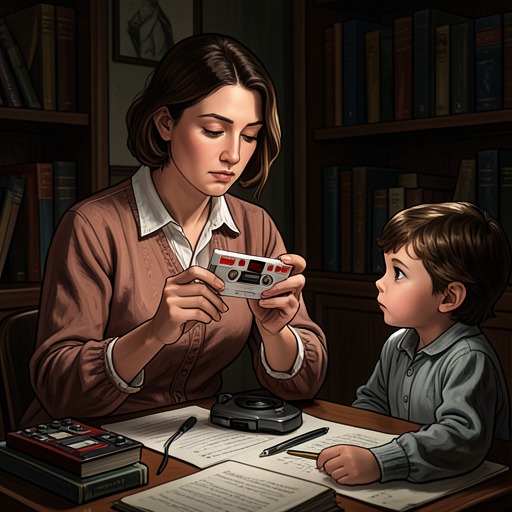
The encounter grows out of Kathy’s attachment to a cassette of Judy Bridgewater’s Songs After Dark. What mattered to her was track three, Never Let Me Go, rather than the singer or the album as a whole. At eleven, she listened repeatedly for the refrain, keeping the cassette wound to that point so she could return to the song whenever she had an opportunity. The limited privacy of Hailsham shaped this ritual: the shared billiards room and Art Room were usually noisy, so Kathy most often played it in her dorm, on a portable cassette player above the radiator.
Kathy did not attend closely to the lyrics. Instead, she imagined a woman who had been told she could not have children, had desperately wanted them, and then, through a miracle, held a baby of her own. The imagined mother sings to the child both from happiness and from fear that the baby might fall ill or be taken away. Kathy understood even then that this interpretation did not fit the rest of the song, but that mismatch did not matter to her. The song’s emotional meaning came from the scene she supplied to it: a mother holding a child she might lose.
That private meaning makes the pillow more than a convenient prop. Kathy’s fantasy gives bodily form to a longing she does not yet understand as a reflection of her own future. She is not consciously staging a message for anyone else; she is alone, with her eyes closed, inhabiting an imagined moment of maternal happiness and fear. Madame’s arrival turns an inward, wordless scene into something witnessed, without making its meaning any clearer to the child at its center.
Madame at the doorway
On a sunny afternoon, Kathy returns to the dorm to fetch something. The curtains have not been drawn back properly, and sunlight falls in shafts through the room, making dust visible in the air. She has not intended to play the cassette, but, finding herself alone, takes it from her collection box and puts it into the player. The volume may have been turned up by the previous listener; whatever the reason, Kathy does not hear Madame before she notices her.
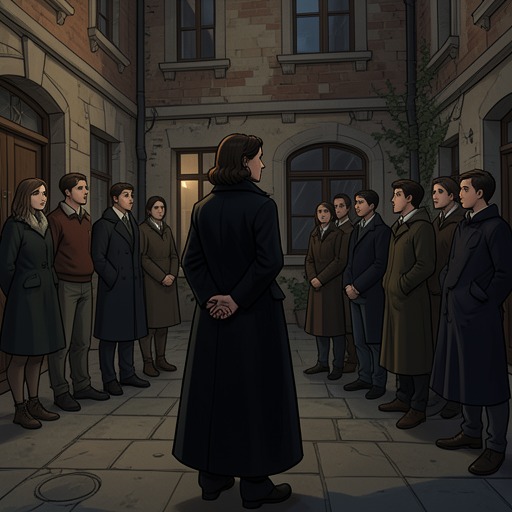
The song is nearly over when Kathy opens her eyes. She has been swaying slowly, holding a pillow to her breast, and softly joining in with the refrain. Madame stands in the corridor, looking through a dorm door left almost half open, as the rules required unless the students were sleeping. She has not come to the threshold. Instead, she remains very still, her head angled to see into the room, and she is sobbing. Kathy even wonders whether one of Madame’s sobs was what broke through the music and brought her out of the moment.
The adult’s reaction reverses the ordinary pattern of authority. Kathy expects that Madame might enter, scold her, or otherwise tell her what to do. Even being reprimanded would give the scene a legible shape: Kathy would know how she was supposed to behave. But Madame does not speak or approach. She watches with the same disturbing look Kathy associates with her gaze, now joined by an emotion Kathy cannot identify, then turns and leaves. Kathy hears her footsteps and sees her hurrying toward the main house, her back hunched. The encounter ends not with an explanation but with the image of Madame still crying as she goes.
Silence and retrospective explanation
Kathy tells none of her friends what happened. Someone notices that she is not herself, but she shrugs and keeps quiet. She is not precisely ashamed; rather, she wishes the incident had never occurred and thinks that not mentioning it may spare both herself and the others. That response recalls the earlier unease surrounding Madame’s attention to the students: the scene leaves Kathy feeling exposed, yet without a shared account that would let the group interpret what has happened.
Kathy eventually tells Tommy about Madame’s visit, a couple of years later, after their conversation by the pond in which he first confided in her about Miss Lucy. By then, the students have been told that they cannot have children. Tommy proposes that Madame cried because she understood the tragedy of seeing Kathy hold her imagined baby when Kathy herself could never have one. His explanation connects Madame’s grief to the fantasy’s central image, but it remains Tommy’s interpretation, not a fact established by Madame. Kathy questions how Madame could have known either that the song meant babies to her or that the pillow represented a child. Those associations existed inside Kathy’s imagination, not in anything she had said or shown to Madame deliberately.
Tommy then half-jokingly suggests that Madame might be able to read minds, or see right inside them. The possibility gives both children a chill, though they giggle and let the subject drop. Their speculation captures the encounter’s unresolved tension: Madame seems to respond to something intimate in Kathy’s fantasy, but the scene offers no evidence that she literally knows its contents. Her tears may indicate recognition of the students’ condition; the precise understanding behind them remains inaccessible.
The cassette and the scene’s afterlife
A couple of months after Madame’s visit, Kathy discovers that the cassette has disappeared from her collection chest. She searches while trying not to show how panicked she is, humming as though she is merely passing the time. She does not connect the missing tape with Madame’s appearance, and, in retrospect, sees no reason to link the events. The loss nevertheless extends the episode’s pattern: what had been a private source of comfort is gone, while the meaning of the encounter remains uncertain.
The episode also gains force from the distance between Kathy’s childhood experience and her later recollection. At the time, she cannot explain Madame’s tears; later, she can place the fantasy beside what the students have learned about their inability to have children and hear Tommy’s interpretation. The retrospective account clarifies the stakes without resolving the adult’s response. The song’s imagined mother, Kathy’s pillow, and Madame’s sobbing converge around an unspoken loss, but none supplies a definitive explanation for the others. What remains is a brief breach between private feeling and public knowledge: Kathy’s improvised image of motherhood is seen by someone who appears to understand its sadness, while the child herself can only register the tears and the retreating figure.